Food tourism is one of the fastest-growing segments in the industry — the global market is projected to hit $1.796 trillion by 2027 — and a big part of that growth comes from how easy food tours are to launch.
Getting started doesn’t require a massive upfront investment. You don’t need a brick-and-mortar location, expensive kitchen equipment, or a large team. Most operators get up and running for under $2k, and the business model is naturally lean: tours typically run $50 to $100+ per person, restaurant partners absorb a chunk of the food costs, and the overhead stays relatively low.
But a lower barrier to entry can also mean more competition. And with more operators vying for the same customers, keeping a consistently booked calendar and actually growing your business takes more than a great route and insider scoop on your city’s best bites.
The operators who build the most successful food tour businesses are the ones who intentionally lay a solid foundation from day one — with an airtight legal structure, strong restaurant partnerships, smart pricing, and tools to sell across every channel where your customers book.
We’re a Tripadvisor brand that’s worked with tour operators across 80+ countries for over 10 years — including thousands of food tour businesses at every stage of growth. This guide covers everything you need to launch your own food tour business and start filling your calendar, from writing your first business plan to managing bookings across multiple channels.
- Writing your business plan
- Food tour startup costs
- 8 steps to design your food tour experience
- How to scale your food tour business after launch
- Common mistakes to avoid
- How Bókun supports you
Write a business plan for your food tour
A food tour business plan doesn’t need to be a formal 50-page document. A clear 2- to 5-page plan is enough to organise your thinking, set goals, and guide the decisions you’ll make in the early days. At a minimum, your plan should cover:
- The niche and market you’re targeting: How is your food tour different from what’s already out there?
- Your target customers: Tourists vs. locals vs. corporate groups, plus age range, income level, and interests. This shapes everything from how you design your tour offerings to which marketing channels are worth exploring.
- Your startup costs and how you’ll fund them: Include a simple financial projection: estimate costs per tour and multiply by your target number of tours per week, then work out how many guests per tour you need to break even.
- Your pricing strategy and revenue target: What you’ll charge per person, how many tours per week you’re aiming for, and what monthly revenue will look like once you’re up and running.
- Your sales channels and marketing plan: Where you’ll sell (your own website, OTAs, partners) and how you’ll drive traffic to those channels.
- A 90-day launch timeline with milestones: Legal setup complete by week X, restaurant partnerships signed by week Y, website live by week Z, first public tour by week W. A concrete timeline keeps you moving and stops the launch from dragging on indefinitely.
Treat your business plan as a living document — revisit and update it as you learn what works in your first few months.
How much does it cost to start a food tour business?
Most food tour businesses launch for somewhere between $800 and $2k in total startup costs, though the high end can stretch to $3k depending on your market and how much you invest upfront in marketing and branding. Here’s where you should expect to spend:
- Business formation (LLC filing): $100 to $500 one-time fee, depending on your state
- General business licence: $50 to $100 per year from your city or county clerk
- Food Handler’s Card: $10 to $15 if your local health department requires one
- Liability insurance: $400 to $900 per year for a general liability policy with $1M to $2M in coverage
- Initial marketing materials: $100 to $300 for business cards, flyers, and any branded items
- Food tasting research: $100 to $300 for visiting and tasting at potential restaurant partners during route planning
- Photography: $200 to $500 for professional photos for your website and OTA listings, though this one is optional, as high-quality smartphone photos also work just fine
- Equipment: a portable payment reader (~$49), a small portable speaker for larger groups (~$30 to $60), and a basic first-aid kit (~$20)
You should also budget for 3 to 5 unpaid test runs with friends and family before you launch publicly. These will come with food costs at partner restaurants that you have to factor in.
Once you’re rolling, your only ongoing costs should be:
- Food costs per tour: These are typically negotiated with each restaurant partner individually
- Commissions to sell on OTAs and online marketplaces: Usually 20% to 30% of the ticket price
- Marketing spend: This varies drastically depending on what you’re doing and the budgets you set
- Website and booking software: Different brands follow different pricing models, and rates can vary significantly, but you can compare pricing for all the top-rated systems here. Our system, Bókun, offers a straightforward subscription ($49/month for all core operational features, a website builder + domain hosting, and growth drivers) and industry-low fees (1.5% for online bookings).
- Guide pay: If you’re hiring other foodies to help run your tours
As a general rule of thumb, you should aim to keep your total ongoing costs around 50% of your ticket price.
8 steps to set up your food tour business for success
1. Research your market & find your niche
Before you invest time and money into building a food tour, you need to know there’s actually demand for it in your city. So the first thing here is to check whether your city can sustain a food tour business. Most city and regional tourism boards publish visitor statistics and seasonal travel data to help you make this determination. You should dig into these resources to get an understanding of:
- How many tourists your city draws in
- Peak seasons
- Whether the food scene is strong enough to keep tours booked year-round or whether you’re looking at a seasonal business
If you feel confident that your city can support a food tour business, then you can get into the specifics of what to offer.
- Audit the existing food tours in your area on online travel agencies and marketplaces like Viator, GetYourGuide, Tripadvisor, Airbnb Experiences, and Google. Note their themes, pricing, group sizes, review counts, and what customers praise or complain about. Reviews in particular will tell you exactly what’s missing.
- Get out and talk to people who work with tourists firsthand. Hotel concierges, tourism office staff, and restaurant owners can tell you what visitors are actually asking for and what’s missing in your market.
- Identify the market gaps. Maybe your city has a wine tour or a popular walking tour that takes travellers to the most popular eateries, but nothing focused on desserts, nothing vegan, no evening cocktail-and-bites crawl, no tour that digs into a specific neighbourhood’s cultural cuisine.
- Consider your own passions and expertise. The best food tour guides are enthusiastic about the food and culture they’re showcasing, and that authenticity is what creates great experiences (and earns those five-star reviews).
A focused niche helps you stand out on OTA listings, attract the right audiences, and build a brand identity that’s easy to market.
Some niche ideas worth considering: gourmet food tours, farmer’s market tours, food truck crawls, historical food tours, cultural and ethnic cuisine tours, pastry and dessert tours, food-and-cocktail pairings, farm-to-table experiences.
2. Handle the legal requirements
The legal stuff isn’t fun, but you absolutely cannot skip it. Here’s all you need to cover yourself.
- Register your business as an LLC. This protects your personal assets — your home, savings, anything in your name — from lawsuits and keeps your tax situation simple.
- Get a free Employer Identification Number (EIN) from the IRS website. You’ll need this to open a business bank account, file taxes, and hire staff down the line.
- Apply for a general business licence from your city or county clerk.
- Check whether your city or state also requires a specific tour operator licence. Places like New York City, Washington D.C., New Orleans, and Savannah do, as do certain EU countries, including Spain and Italy. You can Google “tour operator licence in [your area]” to learn if it’s required and how to apply.
- Get a Food Handler’s Card if your local health department requires one. Even though you’re not preparing food yourself, some jurisdictions require it. It’s usually a short online course and a small fee, but operating without one can result in fines.
- Secure liability insurance. General liability coverage of $1M to $2M typically covers injuries or property damage during tours. Look for providers that specialise in the tourism market, such as BBI, Veracity, or Thimble.
- Set up a digital liability waiver. This should cover food allergies, physical risks like uneven sidewalks and weather, alcohol consumption (guests should acknowledge they’re drinking at their own risk and confirm they’re of legal drinking age), and any other hazards. Make sure every guest signs it during the booking process before the tour.
- Open a dedicated business bank account to keep your personal and business finances separate, and consider a business credit card to earn perks on your spending.
3. Build relationships with local restaurants
It probably goes without saying that without restaurant partners, there’s no food tour. So getting these relationships right is some of the most important work you’ll do before launch.
- Cast a wide net. Identify 8 to 12 potential partners that fit your niche, route, and quality standards. You’ll likely end up working with 5 to 7 after some say no or don’t respond, so start with more than you think you need.
- Visit in person during off-peak hours to meet the owner or general manager. These relationships are built on trust, and a face-to-face conversation lands very differently than a cold email.
- Have a well-prepared pitch (and be ready for some scepticism). Some owners have had bad experiences with food tours that didn’t last, or see the extra logistics as not worth their time. Lead with the mutual benefits and explain how you’ll bring guests during quiet periods, promote their restaurant to new audiences, and give them visibility on your website and OTA listings. Come ready with specifics, too, like how many guests per tour, how often you plan to run, and how you’ll handle no-shows and payments.
- Negotiate food costs and portion sizes upfront. Most operators pay a per-person rate for tastings, with restaurants providing smaller tasting portions rather than full menu items.
- Put agreements in writing. A simple written agreement covering pricing, portion sizes, frequency, and how you’ll handle cancellations or no-shows protects both sides and keeps expectations clear as your business grows.
- Use data as you grow. Guest counts, return visit rates, and review mentions make your pitch significantly stronger when approaching new partners.
- Consider seasonal rotations or guest restaurants to keep the experience fresh for locals and repeat visitors.
4. Design your tour route & experience
The route and experience are what your guests will actually talk about — and what they’ll write in their reviews.
- Choose the right neighbourhood. Look for somewhere pleasant to walk through with interesting sights between stops, and restaurants close enough together that guests aren’t exhausted by the time they reach the last one. Aim for 5 to 10 minutes of walking between stops.
- Consider your format. While walking tours are the most common, also think about bike tours, bus tours, and other transportation formats, depending on your city, your niche, and the distances involved.
- Plan 5 to 7 food stops over 2.5 to 3.5 hours. Enough variety to feel generous without leaving anyone uncomfortably full.
- Give restaurants advance notice of headcount. Most partners need 24 to 48 hours to prep the right number of portions. Build a confirmation process into your operations so they’re never caught off guard.
- Factor in restaurant capacity and timing. Know opening hours, peak service windows, and how long each stop realistically takes — typically 15 to 30 minutes, including food service and storytelling. A tour that runs behind at every stop is a stressful experience for everyone.
- Build a narrative arc. The best food tours tell a story about the neighbourhood, the history of the local cuisine, the chefs, and the culture. That storytelling is what separates a memorable tour from a forgettable one.
- Mix up your tastings. Savoury and sweet, light and heavy, familiar and adventurous. Have a plan for dietary accommodations too — with gluten-free and vegetarian options, and allergy awareness, at minimum.
- Run 3 to 5 practice tours with friends and family before you go public. Time the route, test the portions, refine your storytelling, and sort out logistics like bathroom availability and tricky street crossings. This is also good practice for your restaurant partners, giving them a few low-stakes runs before paying guests come through the door.
- Have a backup plan for every stop. Restaurants close unexpectedly, kitchens fall behind, things sell out. Knowing your alternatives in advance means a hiccup doesn’t derail the whole tour.
- Think about add-ons. Drink pairings at certain stops, a dessert upgrade, a behind-the-kitchen tour, or a take-home goodie bag can all boost revenue without complicating the experience.
5. Set your pricing strategy
Pricing is one of the decisions new operators get wrong most often — usually charging too little out of a desire to be competitive. But underpricing can actually work against you: low prices signal low quality in the tourism industry, and once you’re known as the cheap option, raising prices becomes an uphill battle. Do the math on your actual costs, set a price that comfortably covers them, and don’t be afraid to charge what feels fair.
- Research the local price range. Check out competing food tours in your area to get a sense of what audiences expect and are willing to pay for. As we mentioned earlier, most food tours charge $50 to $100+ per person, depending on food quality, duration, and location.
- Work out your costs per tour. Tally food costs per guest and factor in monthly overhead such as booking software fees, marketing spend, and guide pay. Your price needs to cover all of that and leave you with a worthwhile margin.
- Factor in OTA commissions when setting your base price. Online sales channels typically take a 20% to 30% commission, so if you price without accounting for it, you’ll erode your margins on every OTA booking.
- Require full payment at booking. Unlike many experienced businesses that allow deposits, food tours work best with full prepayment. You’re committing restaurant partners to specific portion counts, so last-minute no-shows are costly. Full payment upfront protects your margins and simplifies operations.
- Set group size limits that balance profitability with guest experience. Most food tours work best with 10 to 16 guests — manageable inside restaurants while generating enough revenue per tour.
- Consider tiered pricing. A standard tour, a premium version with exclusive restaurants or drink pairings, and private group rates for corporate events or special occasions give you options for different customer segments and budgets.
- Use dynamic pricing. Charge more during peak tourist season, on weekends, and around holidays, and offer discounts during slower periods to keep seats filled.
6. Build a booking website & start selling tours online
Every food tour business needs a professional, bookable website. It’s your credibility anchor — the place customers go to learn about your tours, check availability, and book directly with you.
You don’t need a web designer or a big development budget to get one up. Many tour operator software platforms include a website builder with customisable templates, so you can have a branded, mobile-optimised site with an in-built booking engine.
When creating your site, you should add:
- Compelling tour descriptions and detailed itineraries
- High-quality photos
- Clear pricing and availability
- Customer reviews
- A smooth booking and payment process
Bókun gives you all the tools to build a professional, branded booking site, but we’ll talk more about how to do this on our system later on.
Read more:
- How to create a booking website
- How to add a booking system to an existing website
- How to sell tours online: 2 methods + tips to increase bookings
7. Develop a marketing strategy to fill your calendar
Getting your business set up is one thing — getting people to book is another. Here’s where to focus your marketing energy as a new operator.
Get listed and sell across multiple channels
Don’t rely on your website alone. Operators who sell across multiple channels fill their calendars faster and are less vulnerable if a single booking source dries up.
- List on OTAs and online marketplaces. Platforms like Viator, GetYourGuide, Airbnb Experiences, Expedia, Civitatis, TourRadar, and Klook reach millions of travellers who are already in buying mode and actively searching for things to do. Getting listed puts your tours in front of people who may not have ever found you otherwise.
- Get listed on Google Things to Do. It’s free, and it means your tours can appear directly in Google search results when travellers are looking for things to do in your destination.
- List on review platforms. Tripadvisor, Yelp, and Google Business Profile all factor in review counts and ratings when determining how prominently they surface businesses. The more reviews you have, the more visible you become — and the more visible you become, the more bookings and reviews you get.
- Establish reseller partnerships with other travel industry businesses.Travel agents, DMCs, and other tour operators can send you a steady stream of bookings in exchange for a commission. These partnerships take some legwork to iron out, but can become reliable sources of bookings over time.
- Build an affiliate network. Hotel concierges, tourism offices, and even bloggers or social media influencers are the people travellers look to for recommendations. Connect with them, make it easy for them to recommend your tours, and nurture those relationships.
Build your reviews
Reviews drive visibility, build trust, and directly impact how many people book. Ask every single guest to leave a review after their tour. Most happy guests are willing to do it; they just need the nudge.
Read more: 7 ways to earn more Tripadvisor reviews
Show up on social media
Food tours are inherently visual and shareable — the content practically creates itself. Post high-quality photos and short clips from tours, feature your restaurant partners, and make it easy for guests to tag you.
Instagram, TikTok, and Facebook are all worth being on, and consistent posting builds an audience that converts into bookings over time.
Invest in email marketing
Collect customer emails through your booking process and use them in retargeting campaigns. Send newsletters with new tour announcements, seasonal promotions, and local food content to stay top of mind and encourage past guests to come back or refer friends.
Consider paid advertising
Google, Facebook, and Instagram ads can put your tours in front of travellers actively searching for things to do in your city. Start small, test different audiences and creatives, and scale what’s working.
Pursue local press and PR
A feature in a local food publication, lifestyle blog, or city newspaper can drive a significant spike in early bookings and lend credibility that paid ads can’t buy. Reach out to local food writers, pitch your story, and offer a complimentary tour in exchange for coverage.
Bundle with complementary experiences
Partnering with wine or brewery tours, local cooking schools, and other complementary businesses to offer combined experiences increases your average booking value and opens your tours up to new customer segments.
Read more: How to get more tour reservations
8. Set up booking management software to run your operations
Once you’re taking bookings from your website, OTAs, and partners simultaneously, managing everything manually becomes a real problem. Jumping between platforms to update availability, confirm bookings, and send communications is not only time-consuming but also puts you at risk of blunders like double bookings.
Tour operator software acts as the central operating system for your food tour business, bringing booking management, availability syncing, channel management, customer communications, partner management, and reporting into one place. Here’s what to look for:
- Central booking calendar: Every reservation from your website, OTAs, partners, affiliates, and offline channels is in one view, so you’re never reconciling across multiple systems.
- Real-time availability management: When a booking is made, modified, or cancelled, availability updates automatically across every connected channel. If a guest cancels a spot on Viator, that seat immediately opens up everywhere else.
- Automated customer communications: So booking confirmations, mobile tickets, pre-tour reminders, post-tour follow-ups, and review requests are all handled automatically. Set the templates up once and let them run.
- Customer self-service portals: So guests can reschedule or cancel without emailing you back and forth, and any changes are automatically reflected in your calendar.
- Staff scheduling: To manage guide availability and make sure the right guides are assigned to the right tours.
- Check-in tools: To handle day-of arrivals and quickly scan tickets at check-in.
- Digital waivers: Collecting signed waivers digitally before the tour means no paper forms or chasing guests on the day, and a clean record of every signed agreement, stored automatically.
- Tip management: Food tour guides rely heavily on tips, and making it easy for guests to tip digitally at the end of the tour significantly increases the likelihood — and the amount — they tip. Guests are far more likely to tip when the process takes one tap on their phone than when they’re fumbling for cash.
- SMS messaging: Email open rates are good; SMS open rates are significantly higher. SMS is particularly useful for same-day reminders, last-minute meeting-point updates, and any time-sensitive communication where you need to be confident that guests actually saw the message.
- Reporting dashboards: To track bookings and revenue by sales channel, product, and time period. See which OTAs are driving the most business, which tours are filling fastest, and where to focus as you grow.
- Mobile apps for iOS and Android: These offer on-the-go access to your booking calendar and ticket scanning tools for you and your guides out on the street, so you don’t have to manage everything behind a desk.
Read more: Best booking software for food tour companies
How to scale your food tour business after launch
Only after you’ve got a solid foundation and found your groove — your operations are running smoothly, and bookings are coming in consistently — should you start thinking about scaling.
- Add new restaurant experiences and tour products based on data. Your booking software’s reporting dashboard will show you which tours are most popular, which time slots fill fastest, and what guests are asking for. Use those insights to decide what to add next — whether that’s branching into new niches like dessert tours, food truck crawls, or cocktail pairings, or simply adding more of what’s already working.
- Consider operating in a second location or a new city. Once you’ve got a proven model, route, and operational playbook, replicating it in a new neighbourhood or city is a natural next step.
- Invest in marketing more seriously. Early on, you’re scrappy, but as revenue grows, it’s worth putting real budget behind paid ads and SEO to compound visibility.
- Target private and corporate business. Private tours command premium pricing, fill weekday slots that can otherwise sit empty, and diversify your revenue beyond the individual tourist market. Worth building into your offering earlier than most operators do.
- Build a gift card or voucher offering. A popular scaling tactic for food tour operators. Great for holidays, birthdays, and corporate gifting, helping drive sales during slower periods.
- Hire additional guides. As demand outgrows what you can personally lead, look to others who know the local food culture, can work a crowd, and could help lead tours.
- Raise your prices as you build your reputation. As you accumulate reviews and build a track record, you have more leverage to charge more — especially for premium and private tours. A lot of operators never revisit their pricing because they don’t think to do so or are afraid to break what’s working. Increases are totally reasonable, as industry expertise and proven experience justify higher rates.
- Track and refine your distribution strategy. Measure bookings and revenue across every channel — your website, OTAs, partners, and affiliates — to understand where you’re winning business and which channels aren’t contributing as much. Double down on what’s working, cut what isn’t, and test new opportunities.
- Collect guest feedback systematically. Beyond reviews, actively surveying your guests gives you deeper insights into customer experiences that booking data alone can’t tell you: what they loved, what fell flat, and what they wished were included.
- Keep analysing and iterating. Build a habit of regularly checking in on your business performance and making adjustments as you go. None of this works if you only do it once.
Common mistakes to avoid when starting a food tour business
- Skipping the legal setup. This can result in fines, forced shutdowns, or personal liability exposure that far exceeds the cost of doing it right from the start.
- Underpricing your tours. As explained above, this can work against you. You don’t need to be the cheapest in the market to be competitive.
- Launching without test tours. Your first public tour should never be your first tour. Test runs help you and your restaurant partners feel prepared and avoid blunders during actual tours.
- Ignoring reviews. Not actively asking for them — and not responding to negative ones — will hold back your growth more than almost anything else.
- Not tracking your data. Making growth decisions without visibility into which channels, tours, and time periods are performing is just straight guesswork.
- Relying on walk-up business or word-of-mouth alone. The vast majority of travellers book online. If you don’t have a bookable website and aren’t listed on OTAs, you’re invisible to most of your potential customers.
- Managing bookings in spreadsheets. It might work for your first few tours, but once you’re selling across multiple channels, spreadsheets lead to double bookings, missed communications, and operational chaos that leaves a bad taste in customers’ mouths.
- Treating restaurant partnerships as transactional. Check in regularly, share guest feedback, and show up as a reliable and professional partner at every visit. These relationships are what your business runs on.
- Overdoing it on food. More stops and bigger portions might seem generous, but leaving uncomfortably full isn’t a great experience. Keep portions tasting-sized and the experience feeling curated, not excessive.
- Not planning for the off-season. Seasonal dips catch a lot of new operators off guard. Factor slower periods into your financial planning from the start, and have a strategy — discounts, themed tours, corporate bookings — to keep revenue coming in year-round.
Why Bókun is built for food tour startups
Our tour operator software, Bókun, is purpose-built for the tour industry and travel experience providers. As mentioned above, we’ve spent the last decade working with tour guides, activity operators, and attractions of all sizes, from all corners of the globe. And we’ve put that experience into building an all-in-one system that supports every area of your business.
Bókun takes the operational load off your plate and is packed with powerful growth drivers to help you win your first bookings (and keep your calendar filled). Our modules cover everything from designing products and selling tours online to managing customer experiences, racking up reviews, and measuring business performance to scale strategically.
We’ve helped dozens of businesses make their debut, discover new ways to diversify and expand, and see long-term, sustainable growth. You can check out some of their success stories here:
- How Venice Tours achieved a 400% revenue increase through the Bókun Marketplace
- How Tasty Tours NYC integrated Bókun<>Airbnb and saw 381% revenue growth
- How REDRIB Experiences scaled from a startup to a 5-star company with 89% direct online bookings
Our full-featured system is one of the most user-friendly, affordable, and highly rated platforms in the space,with a glowing 4.7 stars on review sites.
Below, we’ll walk you through our system’s core modules and how they help you hit the ground running. You can also test our system yourself with a free 14-day trial (no credit card required).
You get everything to sell food tours online & reach massive, global audiences
Building a bookable website
Bókun’s one-click website builder lets you create a professional, mobile-optimised site from a library of customisable templates. Add your branding (logo, colours, fonts), company details, photos, and videos — and the booking engine is pre-installed so customers can see availability and book instantly.
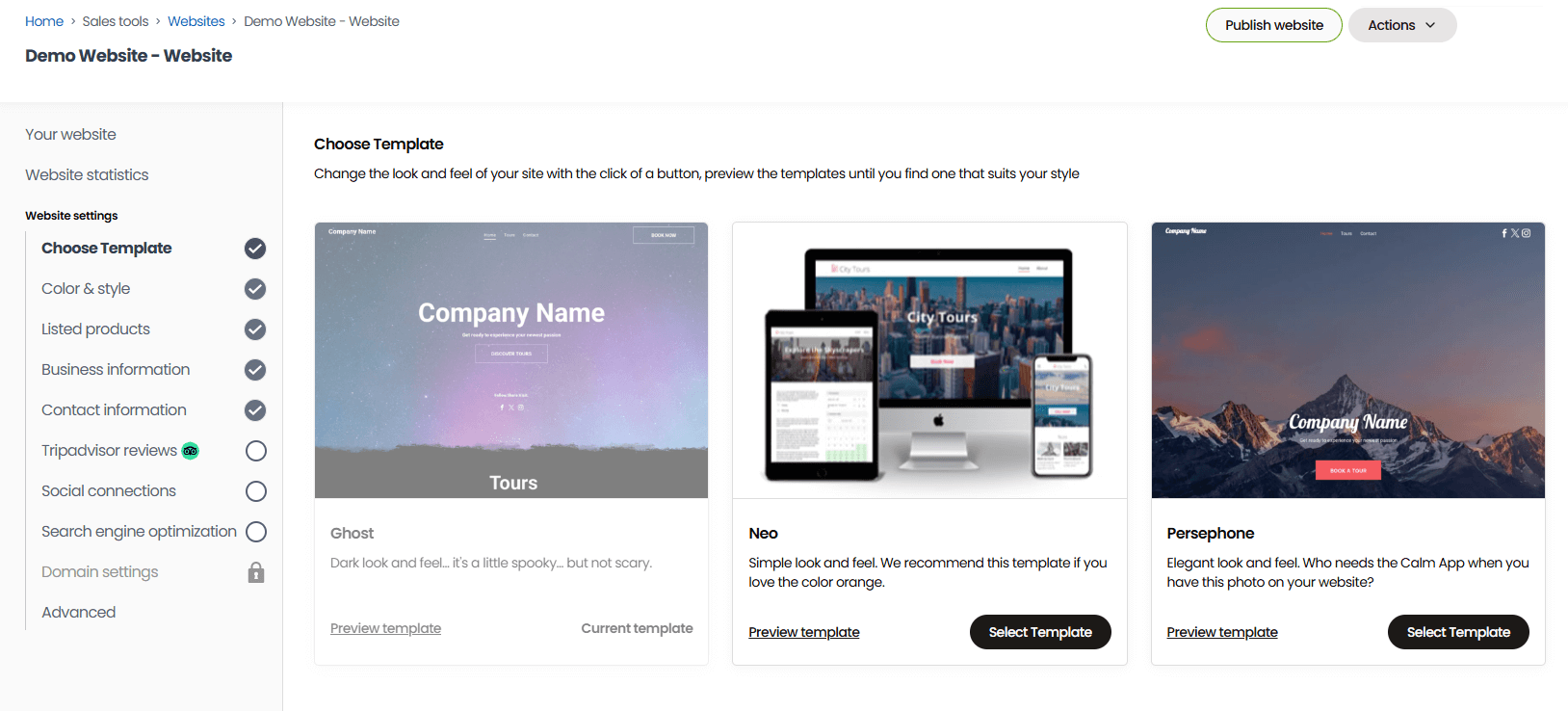
The website builder alone saves food tour operators an average of $3K/year by including domain, hosting, and booking engine in the subscription — no need to pay separately for Squarespace, a domain registrar, or a developer.
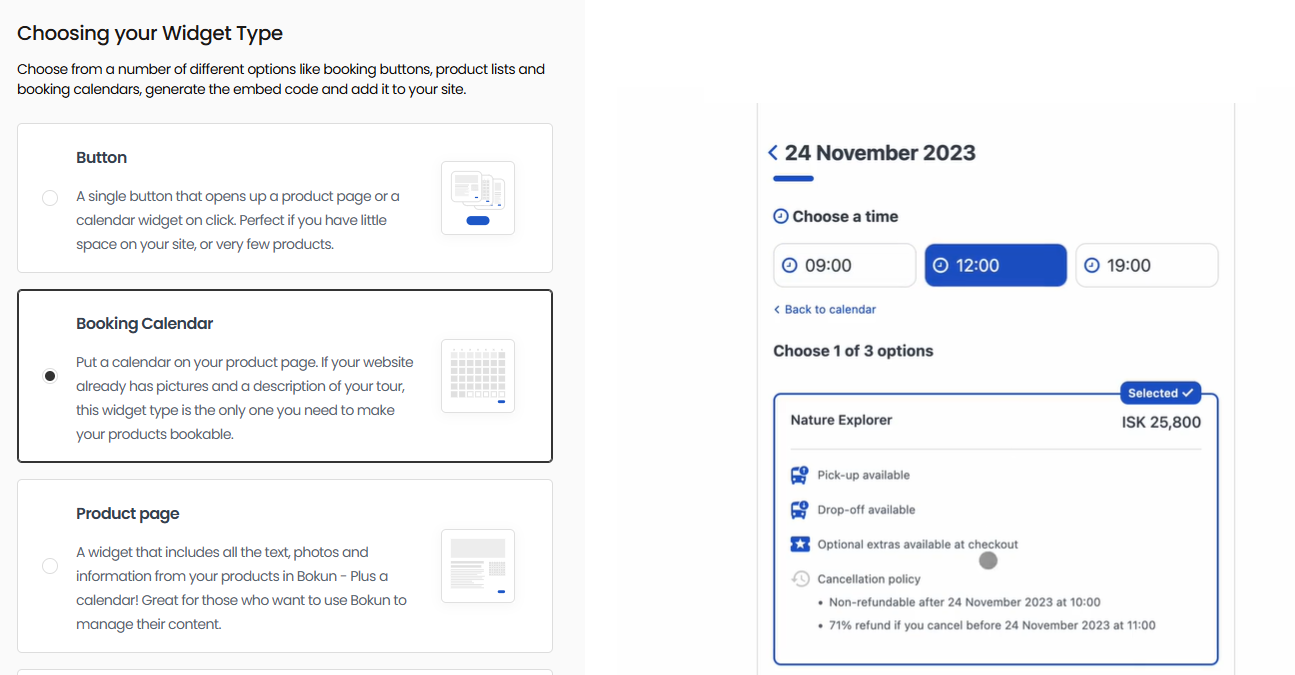
If you already have a website, you can add Bókun’s booking engine widgets (available as “Book Now” buttons, calendar views, product overviews, and product lists) to virtually any platform, including WordPress, Squarespace, Wix, Weebly, and Joomla sites.
Selling on OTAs
Bókun connects with 70+ global OTAs and Marketplaces, including Viator, GetYourGuide, Google Things to do, Airbnb Experiences, Expedia, Klook, Civitatis, Tiqets, and more. We also connect with niche sites tailored to food tours and specific destinations, so you can get in front of the audiences looking for what you offer in your area.
We’re the #1 restech partner across major sites and, as a Tripadvisor brand, we hold exclusive partnerships that other booking systems don’t:
- Our Viator Preferred Partnership lets us offer 0% Bókun booking fees on Viator reservations and free subscription checks (12, 24, or 48 per year, depending on your plan).
- Our GetYourGuide Premium Connectivity Partnership ensures best-in-class API performance and access to the latest features.
- As an approved Google Things to do connectivity partner, Bókun lets you enrol quickly with no lengthy application. Your food tours can appear directly in Google search results when travellers search for things to do in your destination, completely free.
You choose which tours to list on which channels, manage everything centrally, and have bookings from all channels flow into a single calendar with real-time availability updates.
Establishing partnerships & building an affiliate network
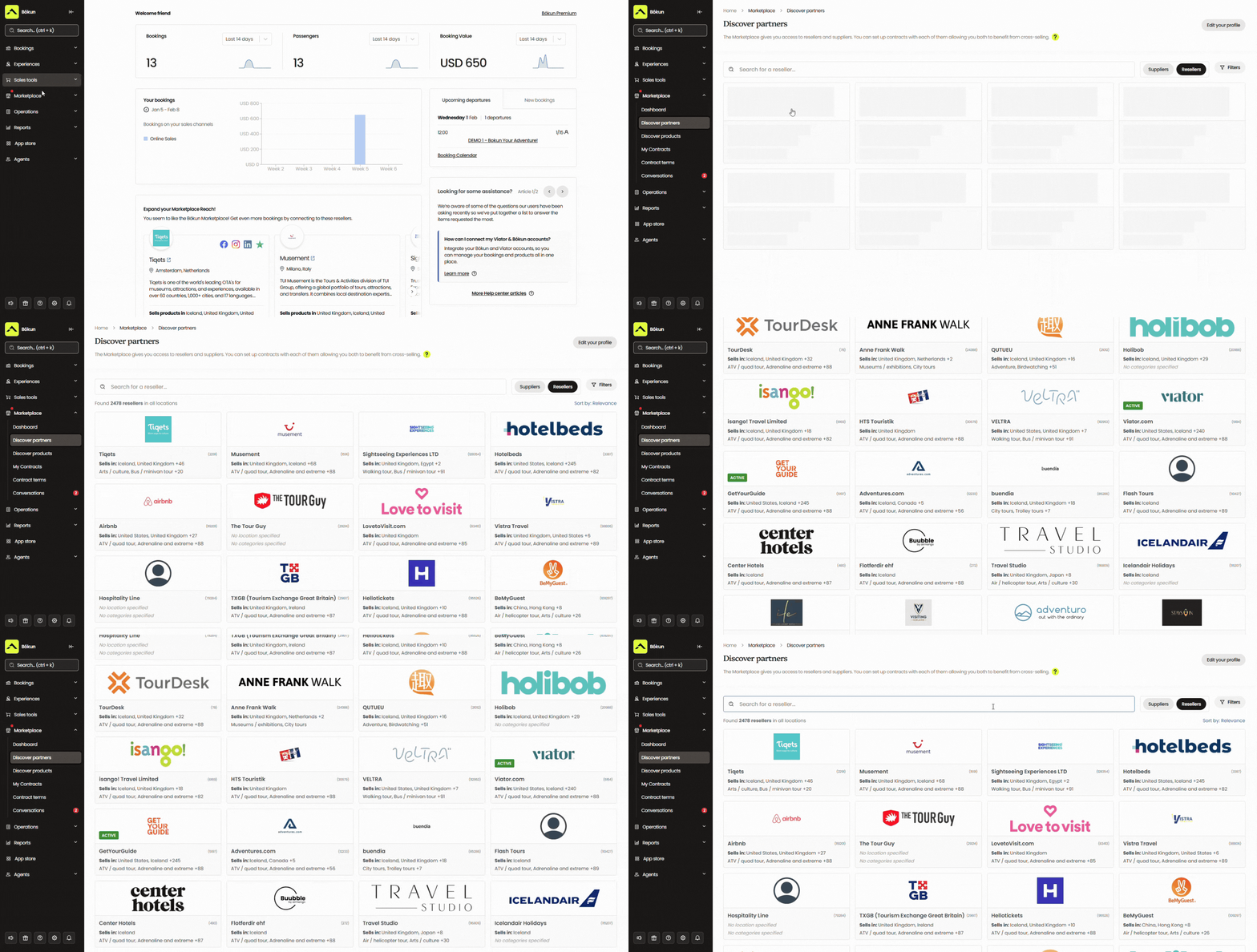
The Bókun Marketplace — one of the largest in-built distribution networks available — gives you access to thousands of travel industry partners, including accommodation providers like hotels and resorts, transportation services, rental companies, travel agents, DMCs, attractions, educational institutions, and other tour operators.
You’re automatically added to the network when you join (at no extra cost), giving you immediate access to business owners who can resell your food tours on their platforms for a commission.
Beyond the Marketplace, our Referral Tracking tools let you build an affiliate network with any business or professional you choose — nearby hotels, other local tour operators, foodie influencers or bloggers, tourism boards, and more.
You can provide affiliates with dedicated booking hubs or trackable booking links, and the system shows you which affiliates drive the most bookings, so you know where to invest your relationship-building efforts.
All your operations management tools in one system
Central booking calendar with real-time availability management
Bókun’s booking calendar is your command centre. It pulls in all upcoming bookings from all sales channels — your website, OTAs, Marketplace partners, affiliates, and offline reservations — so you can see everything in a single unified view.
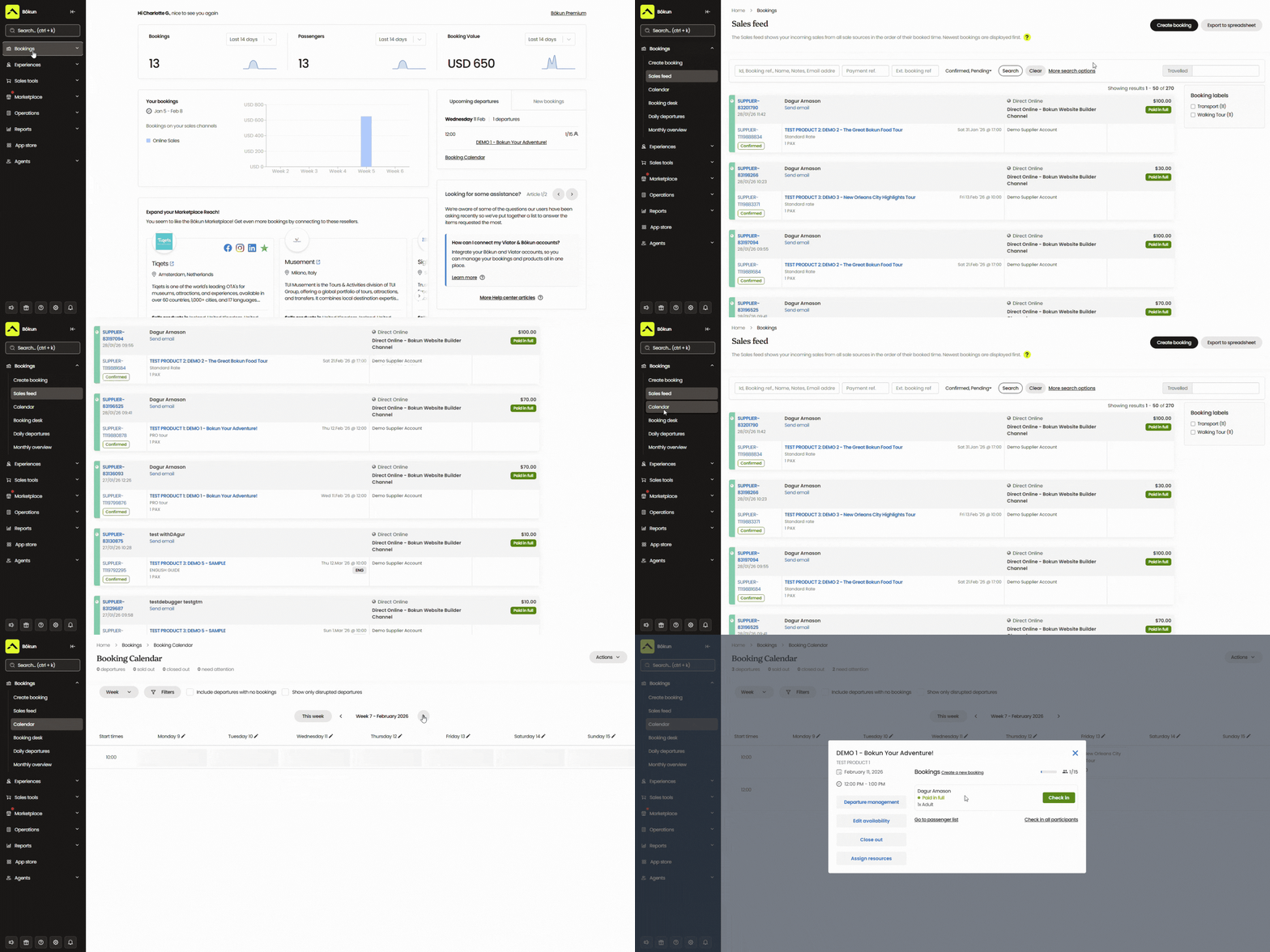
Real-time availability and inventory automatically sync across all connected sites, so customers only see open time slots, regardless of where they find your food tours. This prevents double bookings without any manual management.
Complete product management
Bókun’s Experiences tab is where you build mouth-watering food tour listings. The product builder walks you through each step so it’s super simple.
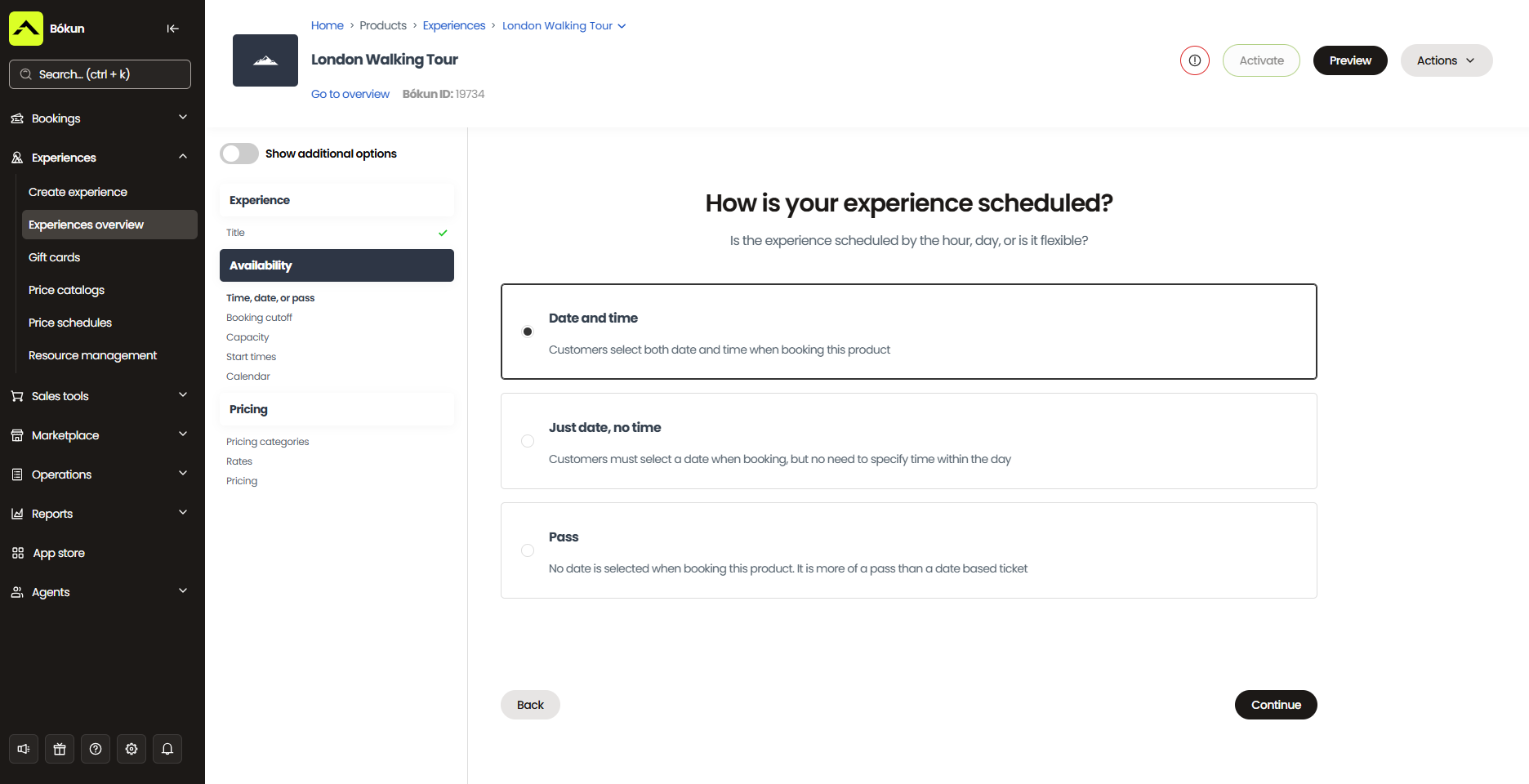
When creating listings, you’ll define the big-picture details, such as tour names, descriptions, meeting-point information, what guests should bring, and any dietary or allergy considerations. Add-ons can be built directly into listings, too.
Then, the product builder will also guide you through adding photos and videos to help your experiences stand out. These are especially important for food tours — great food photography stops the scroll, and a well-shot spread will convert browsers into bookers faster than any written description.
From there, the product builder guides you through availability, pricing, and resources.
- Availability rules let you specify exactly how customers can book. You’ll set which days and times tours run, define recurring schedules, set minimum and maximum group sizes, and add booking cutoffs.
- Pricing is flexible, so you have a lot of options here. You can require full payment upfront (which, again, we’d recommend for food tours), set flat per-person rates, create pricing categories for standard vs. premium tours, offer group discounts, and use dynamic pricing rules to optimise rates automatically — raising prices during peak season or as a tour fills up, for example.
- Resource management lets you assign guides to specific tours, manage any physical inventory, and set allocation rules, so you always have what you need to run tours.
Note: You can save listings as templates to speed things up when adding new tours or seasonal variations. And Viator users can import products directly into Bókun to skip the manual setup.
Customer management: CRM, automated communications & self-service portals
Bókun’s CRM stores all your customer data in one place — guest profiles, contact details, booking history, and communication records. As your list grows, this becomes the foundation for any retention or remarketing activities.
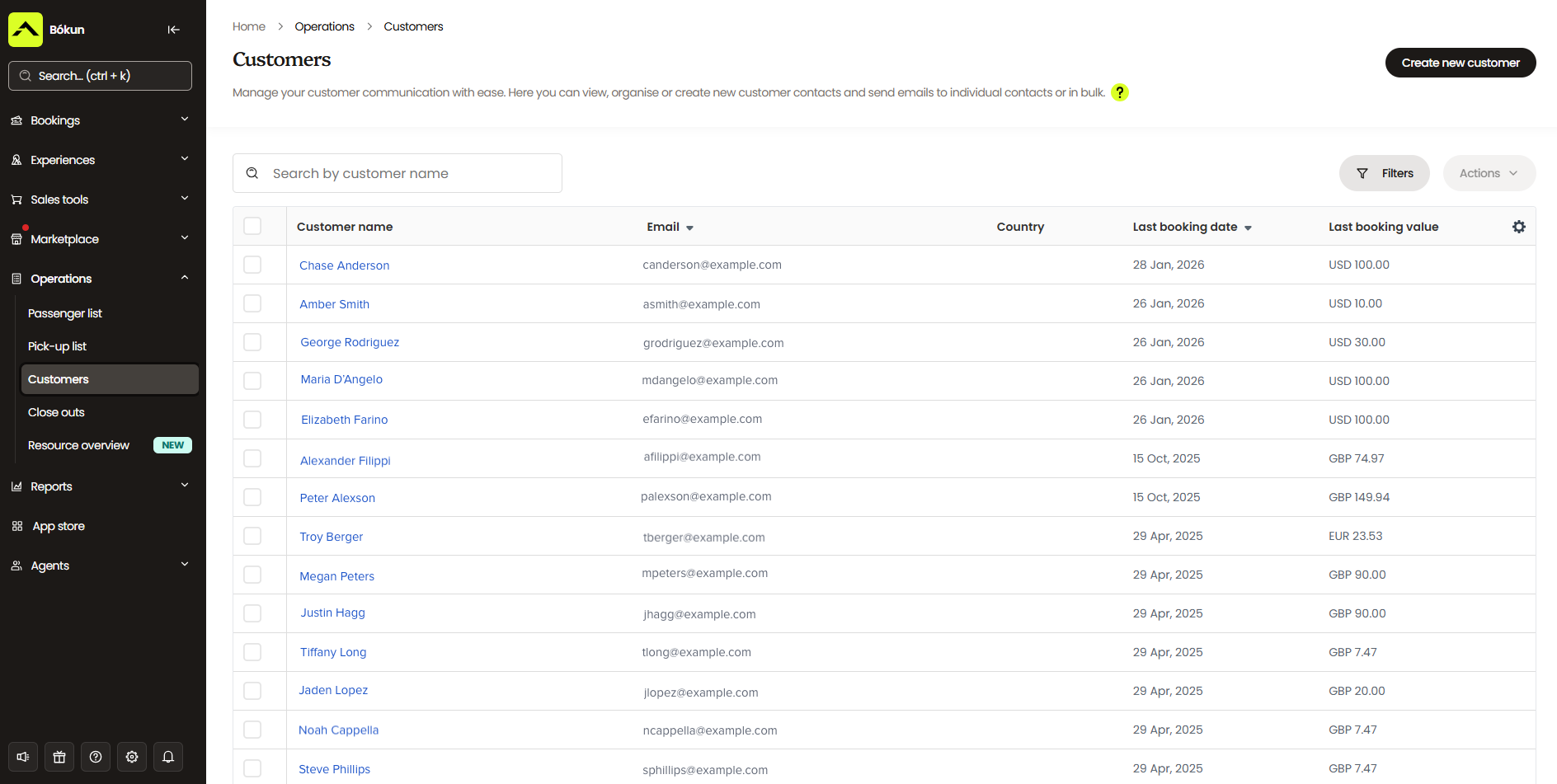
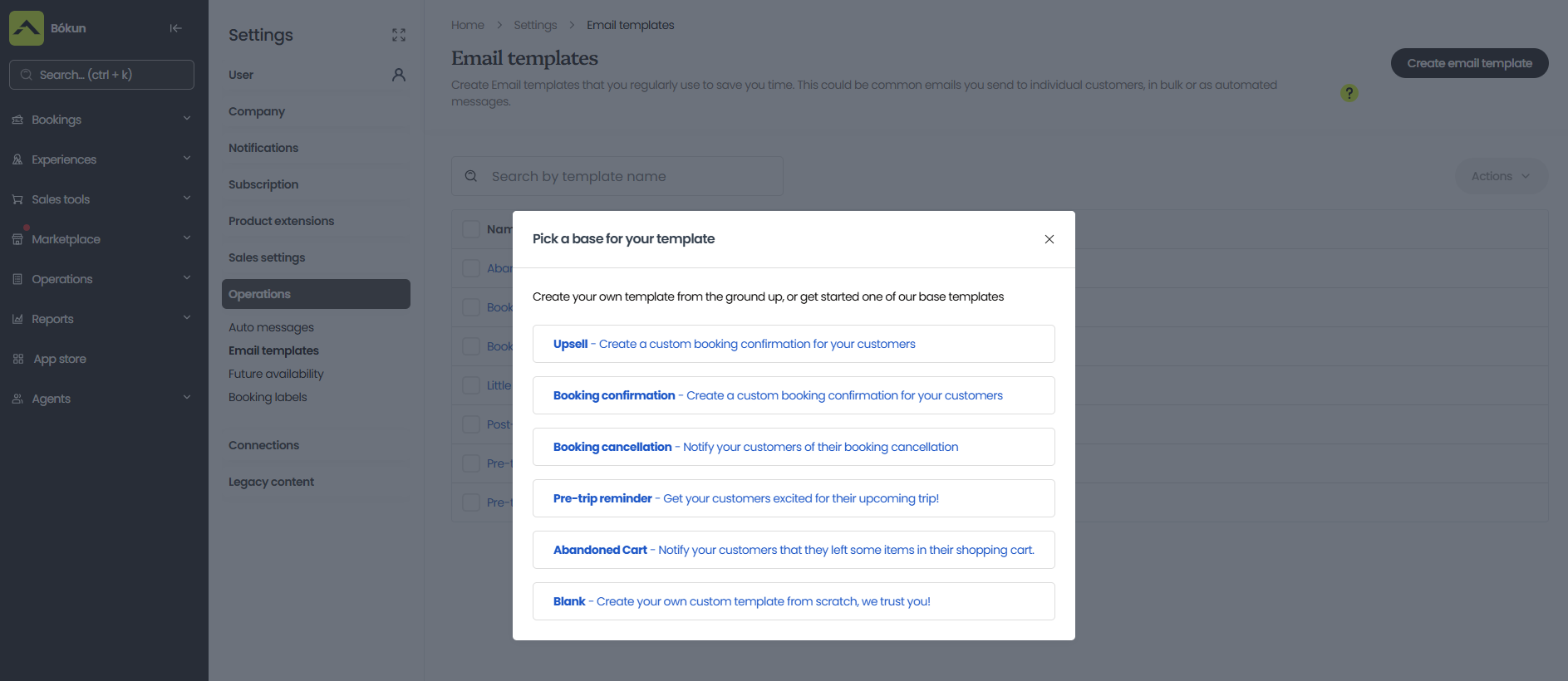
The automated communications tools pair with the CRM to handle every standard customer touchpoint without manual effort. Bókun comes with a library of email templates covering booking confirmations, mobile tickets, pre-tour reminders, post-tour follow-ups, and review requests — all customisable to match your brand voice.
Beyond standard booking emails, you can build and schedule your own templates for any marketing initiative: new tour announcements, seasonal promotions, newsletters, abandoned cart nudges, loyalty discounts, or anything else you want to send to specific customer segments.
Customers also receive access to self-service portals through their confirmation email. From there, they can view their booking details, check the meeting point information, purchase last-minute add-ons, and reschedule or cancel without contacting you. Any changes they make sync back to your calendar automatically and trigger updated confirmation emails on their end.
Check-in tools
When a booking is confirmed, Bókun automatically sends the guest a mobile ticket. On tour day, your guide scans those tickets using Bókun’s mobile app to confirm attendance.
The app also gives on-the-go access to the full booking manifest for their tour, so they can see who’s coming, check for any notes or special requests, and manage the departure from their phone. No hassling with clipboards and printed guest lists!
Reporting dashboards
Bókun’s reporting dashboards let you measure bookings and revenue by sales channel, product, time period, and more. You can identify which channels and partners bring the most business, which food tours are most popular, which time slots fill fastest, and seasonal trends.
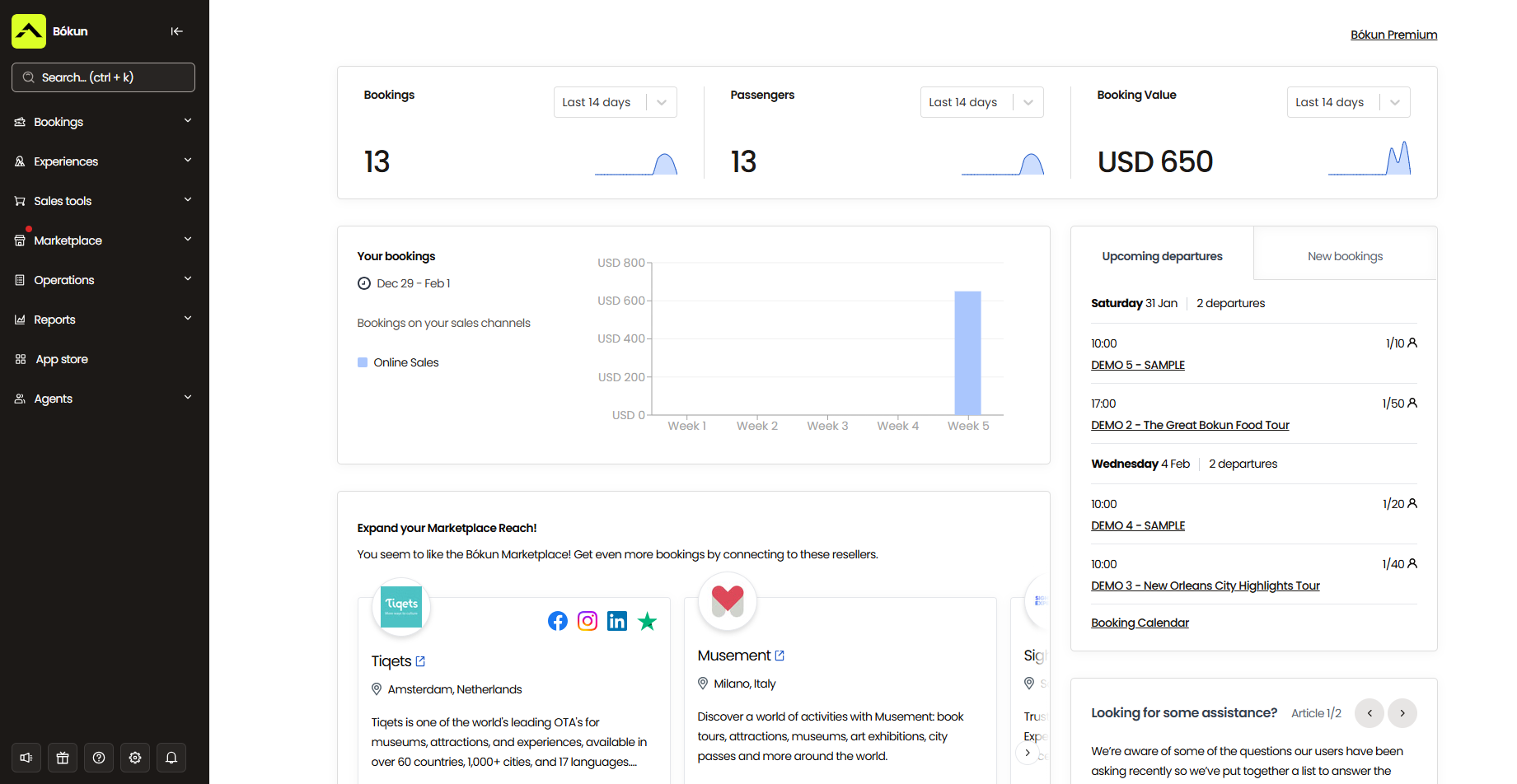
These insights help you make informed decisions to drive growth: double down on the channels that work, adjust pricing where needed, and create new tours based on actual data.
The Bókun App Store
The App Store lets you extend Bókun with add-on modules beyond the core platform. For food tour operators, the most relevant are:
- Digital waivers: Guests complete and sign their liability waiver digitally before they ever show up to the meeting point. Every signed waiver is stored automatically in Bókun against the guest’s booking record.
- Tip management: Guides are added to the platform as staff members, and at the end of a tour, guests can tip digitally in a single tap through their phone. Tips are logged and tracked through Bókun, making distribution straightforward and removing the awkwardness of cash entirely.
- SMS messaging: Send automated or manual text messages to guests directly from Bókun. Useful for same-day reminders, last-minute meeting point changes, weather updates, or any time-sensitive communication where you need confidence that the message actually gets seen.
- Advanced reporting: This adds deeper analytics to the standard reporting dashboard, with more granular breakdowns by product, channel, time period, and customer segment.
Bókun is affordable & accessible for everyone — even the smallest startups
We designed Bókun to be super user-friendly and require zero training — you don’t need to be a tech guru to make the most of our system. Food tour operators can be up and running in an afternoon, which matters when you’re a one-person team trying to minimise launch times.
Here’s how pricing works:
- The START plan is $49/month with industry-low 1.5% booking fees — compared to competitors that charge 3% to 8% booking fees plus higher subscription costs.
- Offline bookings are completely free to manage.
- Bókun waives booking fees on Viator reservations and offers (12, 24, or 48) free yearly product checks.
- All the features discussed above — the website builder, domain hosting, booking engine, Marketplace access, OTA connections, central calendar, CRM, and reporting — are included in the START plan, so everybody has what they need to run a successful operation from day one.
And as your business grows, Bókun grows with you. We offer two enterprise plans — PLUS and PREMIUM — to support you no matter how far you scale. Whether you’re running a single route or expanding to multiple cities, the platform handles it.
You can explore Bókun with a 14-day free trial (no credit card required) to see how it can help you get started in the food tour industry. Start building your website, connect with Viator, explore the Marketplace, and manage bookings before committing.